
If there is broad support for gender equality, why does unpaid care work still fall so heavily on women? This question sits at the heart of a paradox visible across Southeast Asia.
In the Philippines, for example, attitudes towards gender equality are relatively progressive. Yet women's participation in the labour force remains significantly lower than men's, and women spend nearly three times as much time as men on unpaid care.
Indonesia shows a similar pattern. Women are increasingly educated and the country has ambitious goals for their workforce participation, yet they still spend more than twice as much time on unpaid care as men.
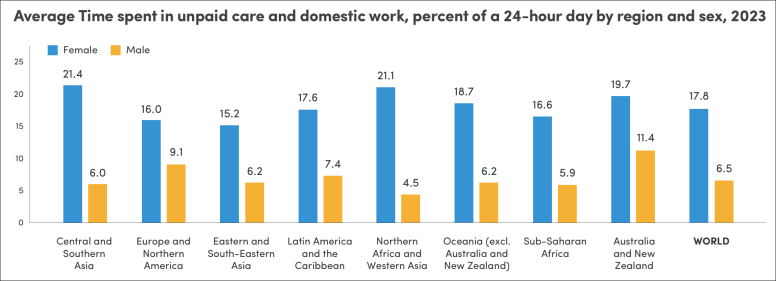
Across Southeast Asia, answers to the care question can no longer be postponed. Families are changing, populations are ageing, migration is reshaping households, and economies increasingly rely on women’s paid work, yet unpaid care is still treated as if households – and particularly the women within them – can simply absorb it. Part of the answer lies in how we frame the challenge.
Gender norms and care systems are often treated as separate domains – one behavioural, the other structural. But they are deeply interconnected. Norms shape expectations around care, while care systems shape whether more equal choices are possible in practice. By care systems, we mean the policies, services, workplaces and community arrangements that shape the way in which care is provided across society.
Two bodies of evidence, one shared insight
This interconnection is highlighted in two recent research publications from Investing in Women (IW), an initiative of the Australian Government in Southeast Asia, in partnership with the Global Institute for Women’s Leadership at the Australian National University.
The Social Norms, Attitudes and Practices Survey (SNAPS) examines what people think, what they do, and what they believe others expect when it comes to gender equality. It finds that many individuals support an equal sharing of caregiving and economic roles, but that behaviour often lags behind this attitude.
In parallel, the Future Demand for Care research looks at how care needs are evolving across countries. It shows that demand for care is rising because of structural shifts – such as population ageing, urbanisation, migration and climate-related pressures – and that traditional, family-based systems are increasingly unable to absorb the demand for care.
Each study answers a different question. But when brought together, they illuminate a shared challenge: why progress stalls even when people express support for gender equality.
The evidence is strikingly consistent across countries. In both the Philippines and Indonesia, SNAPS finds that the support expressed for more equal sharing of unpaid care and income-earning roles is often stronger than people's actual behaviour. The largest gaps appear in areas such as childcare and housework – as opposed, for example, to caring for the elderly or family members with disabilities – suggesting that attitudes alone are not enough to shift everyday practices.

A useful lens: software and hardware
One way to think about this interaction is through a simple analogy. Gender norms are the software, shaping expectations about who should care and who should work, and what kinds of care and work roles are appropriate to which gender. Care systems are the hardware, determining whether more equal arrangements are possible.
In many contexts, parts of the software are already updating. Yet a critical bug remains: people often underestimate how much others support gender equality. When people assume support for equality is rare, they may hesitate to act on their own beliefs. At the same time, the hardware has not always kept pace. Support systems outside the home remain inadequate in addressing care needs, and this creates pressure within households.
When care systems and norms become misaligned, the consequences are clear. Many people support more equal sharing of care, yet behaviour lags behind. Even when households support equal sharing of unpaid care and economic roles, they might not have the practical or logistical means to put this into practice. Meanwhile, care demands across Southeast Asia continue to expand.
When care needs increase without adequate support, households must absorb the pressure somehow. Women often reduce their working hours, shift into informal work or leave employment altogether. Even households that support equality can revert to traditional arrangements when alternatives are limited. As a result, equality becomes aspirational rather than practical.
A reinforcing cycle
Crucially, the relationship between gender norms and care systems is not one-directional. It is mutually reinforcing. Norms shape systems.
When care is seen as a private, primarily female responsibility, there is less demand for public investment in care services. This can influence policy attention or the pace at which formal care systems expand or evolve. In Latin America, for example, advocacy around the recognition and redistribution of unpaid care work has led to innovations in how care is funded and delivered.
At the same time, systems shape norms. When care support is limited, households fall back on traditional gender roles. When care systems are more robust – when services are accessible, and workplaces are responsive – more equal behaviours become feasible and, over time, more normal.
This creates a cycle. It can be a vicious cycle, where weak systems and restrictive norms reinforce inequality. But it can also be a virtuous cycle, where improvements in one area accelerate progress in the other.
Evidence increasingly suggests that norms shift fastest when more equal behaviours become visible. Highlighting positive deviance or early adopters – individuals, families, workplaces and communities that already demonstrate more equal sharing of care – can help to correct misperceptions, reduce social sanctions and show that alternative behaviours are not only possible, but also increasingly common.
From research to practice
Recognising the interaction between gender norms and care systems matters for policy and practice. Care reform without norm change risks creating interventions that remain underused or reinforce assumptions that care is primarily women's responsibility. Equally, norm change without care reform risks increasing aspirations without increasing people's ability to act on them.
In addition, care reform and norm change do not necessarily advance at the same time. Governments can introduce policies, services and programmes that produce visible improvements in access to care over relatively short periods, while social norm change has a longer tail, calling for investments in direct and deliberately designed interventions. Progress is most likely when both care reform and norm change move together, even if they move at different speeds.
At Investing in Women, we have used this combined framing as a springboard for dialogue across government, private sector and civil society stakeholders. Care has proven to be a particularly valuable entry point for engagement. Unlike discussions of social norms, which can sometimes feel too abstract or difficult for the engagement of stakeholders outside the gender equality sector, care is immediately visible. Households experience it every day.
Businesses encounter it through workforce participation, absenteeism and retention. Governments encounter it through labour force participation, demographic change and economic growth. Yet the practical question of who is expected to provide it is deeply shaped by gender norms.
By bringing together evidence on both social norms and care systems, we have seen a movement away from siloed conversations, where norms are treated as an advocacy issue and care as a service delivery challenge. Speaking to norms and systems in one breath has helped to create a shared understanding of the challenge and a more integrated set of responses.
In the Philippines, for example, discussions around a National Care Economy Policy Framework are helping to position care as an economic as well as gender equality issue. In Indonesia, a Care Economy Roadmap and National Action Plan has moved care up the policy agenda.
Yet policy change alone is not enough. Making care itself more visible, supporting more equal sharing of it, and strengthening the systems that enable it are all part of the same challenge.
If women's economic equality is to advance, norm change and care reform must be pursued together so that equality becomes not only desirable, but achievable in everyday life.


About the authors
Kim Patria and Maesy Angelina are from the leadership team of Investing in Women, an initiative of the Australian Government that promotes women’s economic equality in Southeast Asia. Kim leads the gender norms workstream of IW, while Maesy leads the care economy workstream.


