
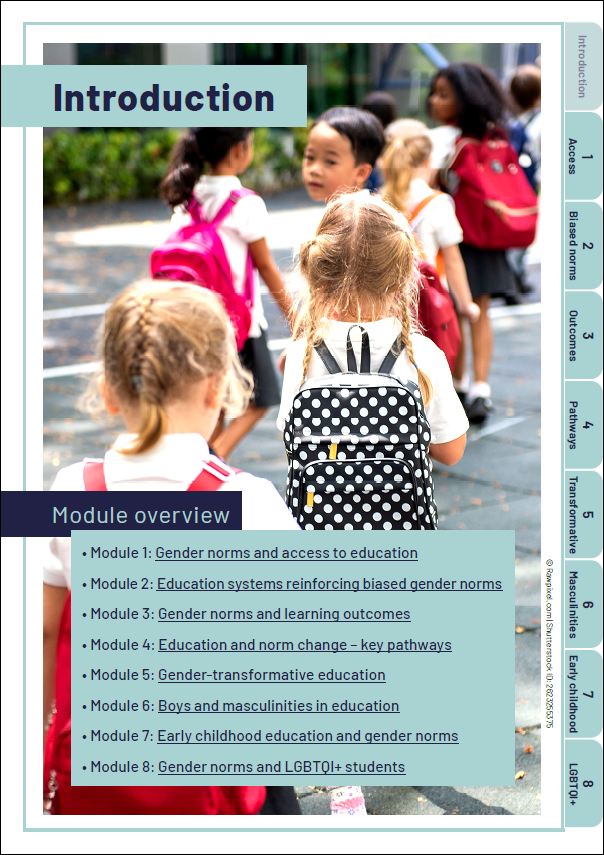
Education has enormous potential to catalyse gender equality, but it can also reinforce biased norms that limit all students. This guide aims to help readers understand how gender norms affect education and how education can help transform gender norms.
- The first part of the guide explains how gender norms interact with other norms and biases to affect different students from different socio-economic and cultural backgrounds in different ways.
- The second part outlines how education can help nurture equal gender norms. It highlights a set of entry points, from individual schools to education policy for gender-transformative action.
- The third part of the guide focuses on specific groups and issues, highlighting the ways that schools can reinforce or nurture gender equality values among boys, gender norms in early childhood education, and how gender norms affect LGBTQI+ students.
The guide draws on studies and examples from different world regions and high, middle and low income countries to illustrate both common patterns and what is specific to particular contexts. Each of the eight modules features case studies and identifies relevant resources for further reading.
Module overview
- Introduction: Introduction, acknowledgements and acronyms
- Module 1: Gender norms and access to education
- Module 2: Education systems reinforcing biased gender norms
- Module 3: Gender norms and learning outcomes
- Module 4: Education and norm change – key pathways
- Module 5: Gender-transformative education
- Module 6: Boys and masculinities in education
- Module 7: Early childhood education and gender norms
- Module 8: Gender norms and LGBTQI+ students
Module 1:
Gender norms and access to education
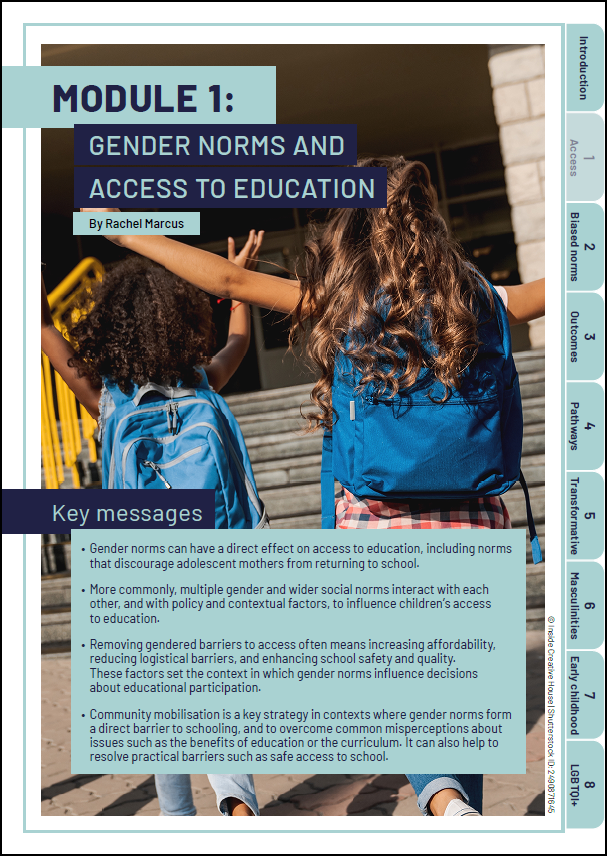
This module explains how gender norms interact with other factors to influence children’s access to education. It shows that although sometimes gender norms form a direct barrier, more often it is the interaction of gender norms, the education system, and the wider context that affect access. The module then discusses ways to reduce barriers that interact with gender norms to limit children’s access to education.
Key messages
- Gender norms can have a direct effect on access to education, including norms that discourage adolescent mothers from returning to school.
- More commonly, multiple gender and wider social norms interact with each other, and with policy and contextual factors, to influence children’s access to education.
- Removing gendered barriers to access often means increasing affordability, reducing logistical barriers, and enhancing school safety and quality.
- These factors set the context in which gender norms influence decisions about educational participation.
- Community mobilisation is a key strategy in contexts where gender norms form a direct barrier to schooling, and to overcome common misperceptions about issues such as the benefits of education or the curriculum. It can also help to resolve practical barriers such as safe access to school.
Module 2:
Education systems reinforcing biased gender norms
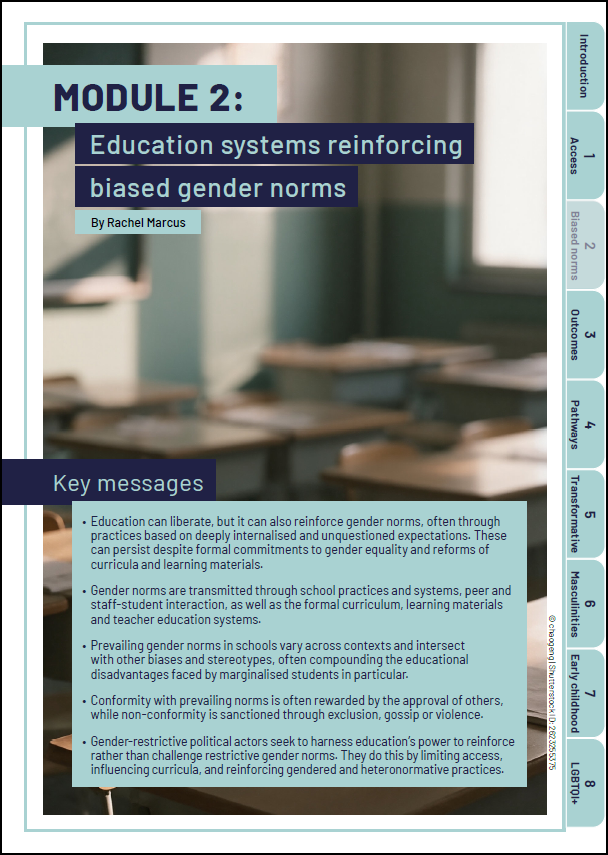
This module explains how schools and education systems often reinforce inequitable gender norms and stereotypes. This is sometimes intentional in contexts where policies and practices emphasise specific visions of gender relations, often framed as part of national or religious values. More commonly, however, it is unintentional, and reflects norms that are so naturalised that they are taken for granted.
The module explains how social norms theory provides insights into how norms are reinforced through social interactions in school settings, before discussing how they are embedded in curricula and learning materials. It then discusses how ‘anti-gender’ or gender-restrictive political forces seek to reinforce conservative gender norms in education. It should be read alongside Module 5, which outlines how schools and education systems can counter these mechanisms to nurture pro-gender equality norms.
Key messages
- Education can liberate, but it can also reinforce gender norms, often through practices based on deeply internalised and unquestioned expectations. These can persist despite formal commitments to gender equality and reforms of curricula and learning materials.
- Gender norms are transmitted through school practices and systems, peer and staff-student interaction, as well as the formal curriculum, learning materials and teacher education systems.
- Prevailing gender norms in schools vary across contexts and intersect with other biases and stereotypes, often compounding the educational disadvantages faced by marginalised students in particular.
- Conformity with prevailing norms is often rewarded by the approval of others, while non-conformity is sanctioned through exclusion, gossip or violence.
- Gender-restrictive political actors seek to harness education’s power to reinforce rather than challenge restrictive gender norms. They do this by limiting access, influencing curricula, and reinforcing gendered and heteronormative practices.
Module 3:
Gender norms and learning outcomes
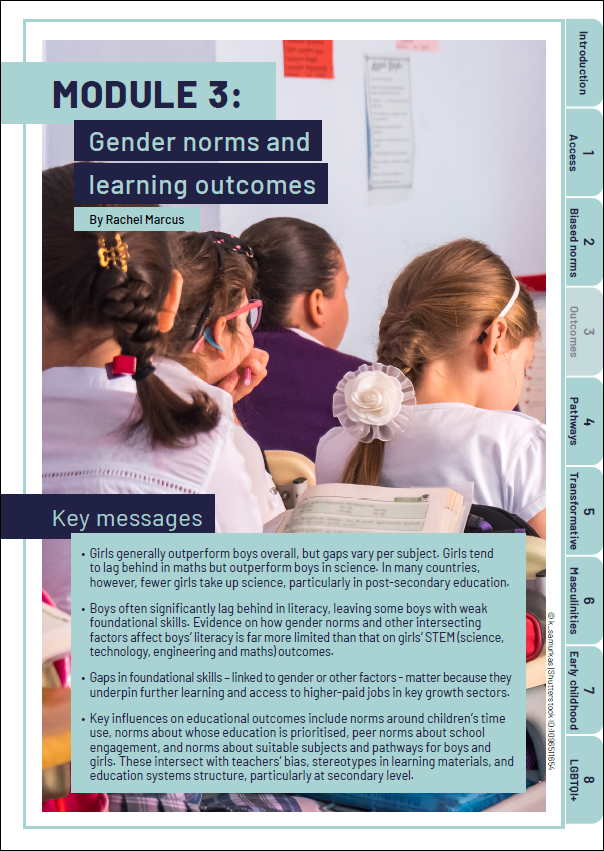
This module discusses how gender norms affect children’s learning outcomes and their uptake of different subjects and study pathways. It begins by outlining data on gender differences in learning outcomes and patterns of subject choice. It then discusses how gender norms contribute to different learning outcomes and educational trajectories, with a focus on STEM, for which the body of evidence is greatest. It also presents highlights from the much smaller body of evidence on masculinity and on outcomes for boys. It is important to note that gender norms are not discussed directly in much of the literature on learning outcomes. The module therefore combines direct evidence on norms with indirect evidence on mechanisms such as time use, the operation of stereotypes and teacher bias.
Key messages
- Girls generally outperform boys overall, but gaps vary per subject. Girls tend to lag behind in maths but outperform boys in science. In many countries, however, fewer girls take up science, particularly in post-secondary education.
- Boys often significantly lag behind in literacy, leaving some boys with weak foundational skills. Evidence on how gender norms and other intersecting factors affect boys’ literacy is far more limited than that on girls’ STEM (science, technology, engineering and maths) outcomes.
- Gaps in foundational skills – linked to gender or other factors - matter because they underpin further learning and access to higher-paid jobs in key growth sectors.
- Key influences on educational outcomes include norms around children’s time use, norms about whose education is prioritised, peer norms about school engagement, and norms about suitable subjects and pathways for boys and girls. These intersect with teachers’ bias, stereotypes in learning materials, and education systems structure, particularly at secondary level.
Module 4:
Education and norm change – key pathways
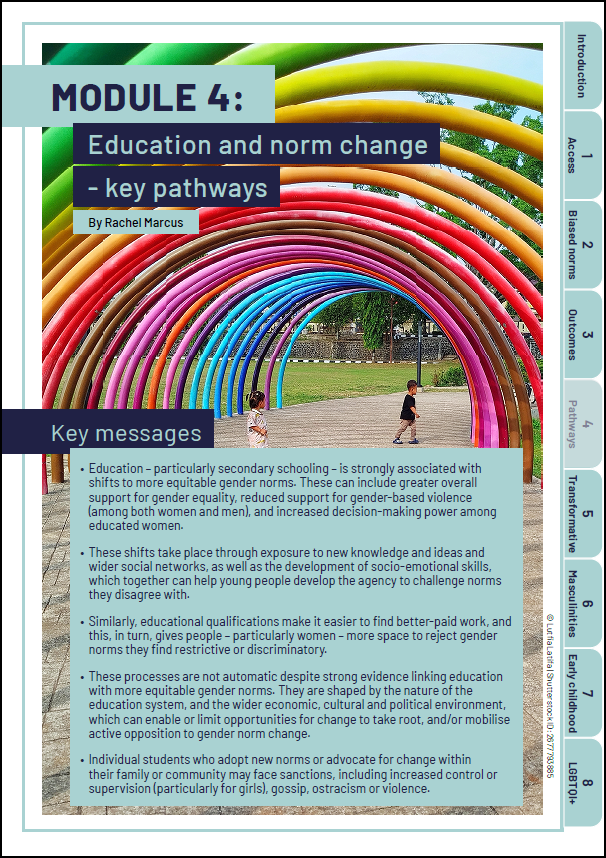
Focusing on school environments, this short module unpacks the different ways in which education can nurture more equitable gender norms, providing an overview of pathways to change. These can take place even in challenging educational, cultural, political and economic contexts, but are more likely to do so where enabling factors are present.
This module outlines the potential for education to promote gender-equitable norms and values. It should be read alongside Module 5, which presents approaches – from policy and system levels through to school and community levels – that can help to reinforce the positive potential of education in this area.
Key messages
- Education – particularly secondary schooling – is strongly associated with shifts to more equitable gender norms. These can include greater overall support for gender equality, reduced support for gender-based violence (among both women and men), and increased decision-making power among educated women.
- These shifts take place through exposure to new knowledge and ideas and wider social networks, as well as the development of socio-emotional skills, which together can help young people develop the agency to challenge norms they disagree with.
- Similarly, educational qualifications make it easier to find better-paid work, and this, in turn, gives people – particularly women – more space to reject gender norms they find restrictive or discriminatory.
- These processes are not automatic despite strong evidence linking education with more equitable gender norms. They are shaped by the nature of the education system, and the wider economic, cultural and political environment, which can enable or limit opportunities for change to take root, and/or mobilise active opposition to gender norm change.
- Individual students who adopt new norms or advocate for change within their family or community may face sanctions, including increased control or supervision (particularly for girls), gossip, ostracism or violence.
Module 5:
Gender-transformative education
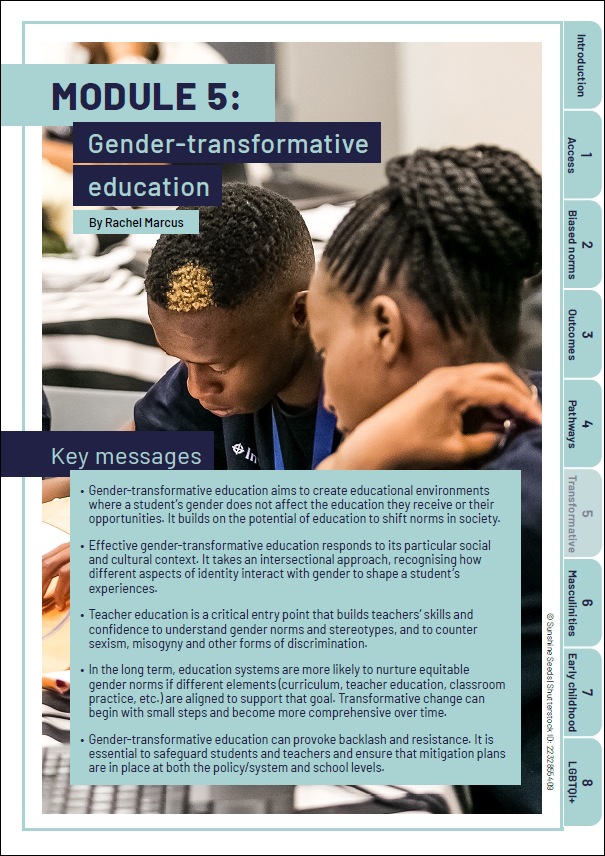
This module outlines actions that education systems can take to nurture equitable gender norms – often known as implementing a gender-transformative approach. Signalling the varied levels of evidence for each approach, it spans actions from the policy and system levels to the school level, and actions with families and communities. It highlights promising actions in national education policies, curriculum, teaching and learning materials, pedagogy, teacher education, supportive school environments and outreach to families.
Key messages
- Gender-transformative education aims to create educational environments where a student’s gender does not affect the education they receive or their opportunities. It builds on the potential of education to shift norms in society.
- Effective gender-transformative education responds to its particular social and cultural context. It takes an intersectional approach, recognising how different aspects of identity interact with gender to shape a student’s experiences.
- Teacher education is a critical entry point that builds teachers’ skills and confidence to understand gender norms and stereotypes, and to counter sexism, misogyny and other forms of discrimination.
- In the long term, education systems are more likely to nurture equitable gender norms if different elements (curriculum, teacher education, classroom practice, etc.) are aligned to support that goal. Transformative change can begin with small steps and become more comprehensive over time.
- Gender-transformative education can provoke backlash and resistance. It is essential to safeguard students and teachers and ensure that mitigation plans are in place at both the policy/system and school levels.
Module 6:
Boys and masculinities in education
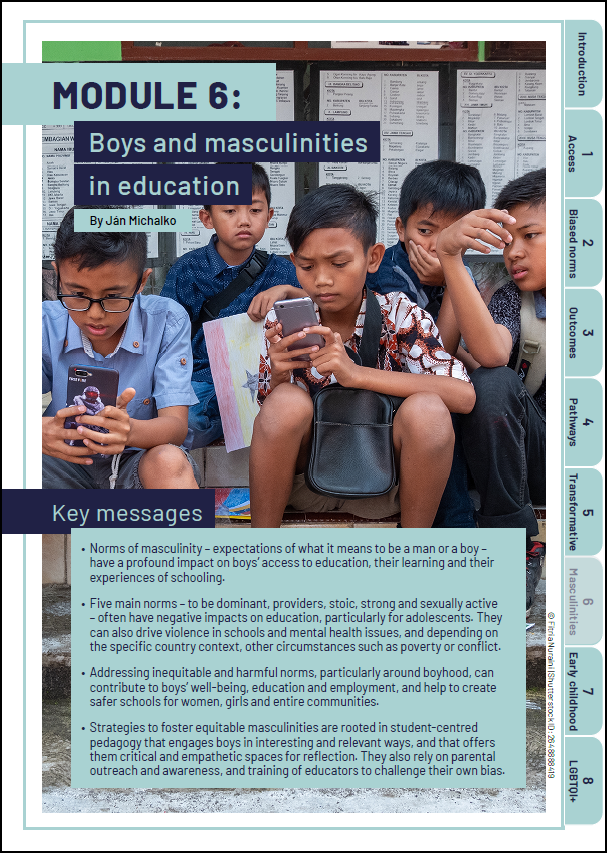
This module explains how a specific set of masculinity norms affects boys’ access to education, as well as their education outcomes and experiences, with a focus on formal primary and secondary schools. It also shows how these norms shape the educational experiences of girls and gender-diverse children and young people, and discusses how gender-transformative approaches that nurture more gender-equitable masculinities can benefit all children.
Key messages
- Norms of masculinity – expectations of what it means to be a man or a boy – have a profound impact on boys’ access to education, their learning and their experiences of schooling.
- Five main norms – to be dominant, providers, stoic, strong and sexually active – often have negative impacts on education, particularly for adolescents. They can also drive violence in schools and mental health issues, and depending on the specific country context, other circumstances such as poverty or conflict.
- Addressing inequitable and harmful norms, particularly around boyhood, can contribute to boys’ well-being, education and employment, and help to create safer schools for women, girls and entire communities.
- Strategies to foster equitable masculinities are rooted in student-centred pedagogy that engages boys in interesting and relevant ways, and that offers them critical and empathetic spaces for reflection. They also rely on parental outreach and awareness, and training of educators to challenge their own bias.
Module 7:
Early childhood education and gender norms
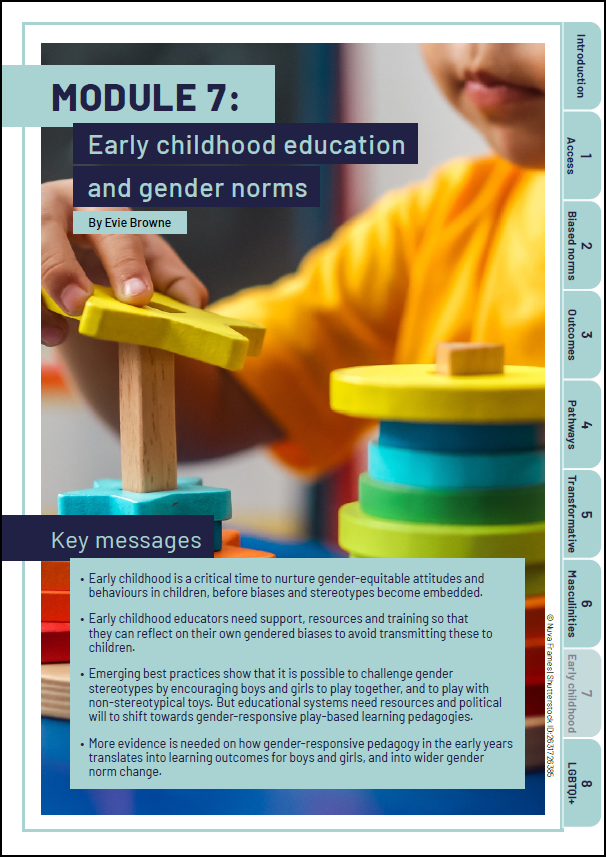
This module examines how gender norms affect early childhood education. It looks at not only how unequal gender norms are often reinforced in pre-schools, but also how they can be transformed in a positive way to promote gender equality. This module should be read alongside Module 5, which covers gender-transformative education in more detail.
Key messages
- Early childhood is a critical time to nurture gender-equitable attitudes and behaviours in children, before biases and stereotypes become embedded.
- Early childhood educators need support, resources and training so that they can reflect on their own gendered biases to avoid transmitting these to children.
- Emerging best practices show that it is possible to challenge gender stereotypes by encouraging boys and girls to play together, and to play with non-stereotypical toys. But educational systems need resources and political will to shift towards gender-responsive play-based learning pedagogies.
- More evidence is needed on how gender-responsive pedagogy in the early years translates into learning outcomes for boys and girls, and into wider gender norm change.
Module 8
Gender norms and LGBTQI+ students
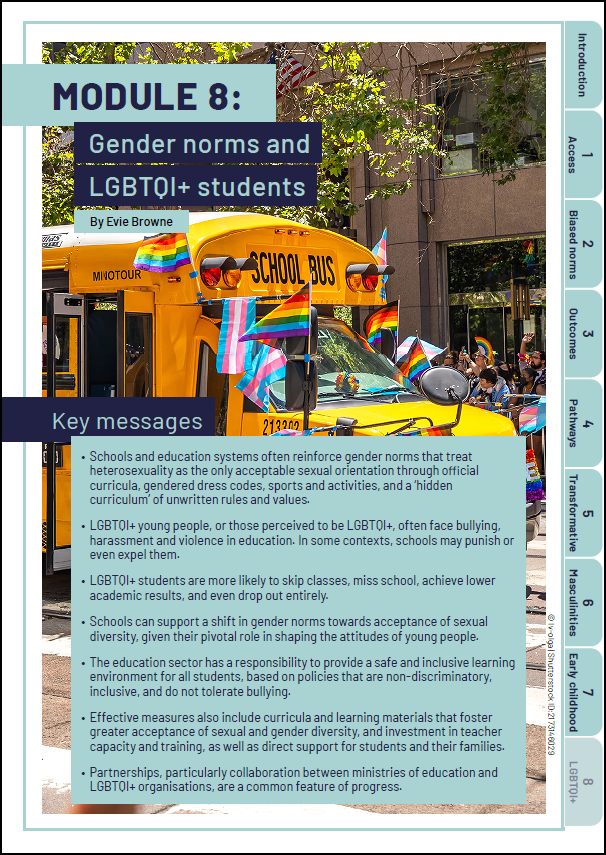
This module examines how gender norms affect the experiences of LGBTQI+ students in formal school settings, from their educational access to their academic achievement. It draws out the impacts of discriminatory gender norms on LGBTQI+ young people, including harassment and bullying that lead to poor academic achievement and drop out. It looks at how gender norms are reinforced in school environments, through curricula, policies and school practices such as binary sex-based dress codes. It also includes a short section on LGBTQI+ teachers. Finally, it provides recommendations on how to address homophobic, queerphobic and transphobic norms in schools.
Key messages
- Schools and education systems often reinforce gender norms that treat heterosexuality as the only acceptable sexual orientation through official curricula, gendered dress codes, sports and activities, and a ‘hidden curriculum’ of unwritten rules and values.
- LGBTQI+ young people, or those perceived to be LGBTQI+, often face bullying, harassment and violence in education. In some contexts, schools may punish or even expel them.
- LGBTQI+ students are more likely to skip classes, miss school, achieve lower academic results, and even drop out entirely.
- Schools can support a shift in gender norms towards acceptance of sexual diversity, given their pivotal role in shaping the attitudes of young people.
- The education sector has a responsibility to provide a safe and inclusive learning environment for all students, based on policies that are non-discriminatory, inclusive, and do not tolerate bullying.
- Effective measures also include curricula and learning materials that foster greater acceptance of sexual and gender diversity, and investment in teacher capacity and training, as well as direct support for students and their families.
- Partnerships, particularly collaboration between ministries of education and LGBTQI+ organisations, are a common feature of progress.