
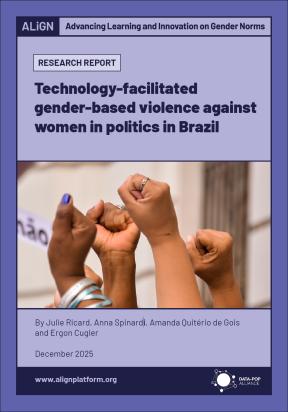
Technology-facilitated gender-based violence (TF-GBV) is silencing women in politics and undermining democracy.
From sexist slurs on X to coordinated threats on encrypted platforms, TF-GBV is pushing women to withdraw from political life. Its impacts fall hardest on those already marginalised by intersecting inequalities based on race, age, sexuality and gender identity.
TF-GBV does not occur in isolation. It is fuelled by rising anti-gender movements, expanding digital disinformation networks, and persistent resistance from technology companies to meaningful regulation.
Political parties, which are central to democratic processes, should be at the forefront of prevention and response. Yet, many of their institutional structures and cultures remain dominated by patriarchal norms, which translates into a lack of clear policies and a failure to support the very women who stand for them. How can parties do better?
ALIGN partnered with Data-Pop Alliance in Brazil and the development Research and Projects Centre in Nigeria to investigate. Researchers analysed hundreds of Telegram and X messages, reviewed party policies across both countries, and interviewed dozens of women politicians and party leaders to understand how TF-GBV operates, its impacts, and what effective party responses could look like.
The findings are clear: TF-GBV is systemic, often coordinated, and increasingly embedded in political culture – this abuse intensifies during elections, but also when women gain a high-profile or occupy high-visibility roles in politics.
Women across ideological lines face psychological harm, physical threats and significant barriers to participation. Party leaders acknowledge the problem but rarely grasp its digital dynamics, and almost no party has robust mechanisms to prevent or address TF-GBV, including when it comes from their own members or supporters.
Yet solutions exist. They range from legal and regulatory reforms to party-level codes of conduct, training, reporting pathways, support networks and resourcing for women politicians. Effective strategies must be grounded in local political realities. It relies on one essential ingredient: the political will to reject the notion that the harms caused by TF-GBV are an inevitable cost women must bear to participate in public life.
This project was carried out between November 2024 and December 2025 by partners in Brazil and Nigeria.

About the research partners
Data-Pop Alliance
Data-Pop Alliance (DPA) is a non-profit, think-and-do-tank, created in 2013 by the Harvard Humanitarian Initiative, MIT Connection Science, and ODI. DPA brings together researchers, practitioners, and activists driving for positive change in the world using data and AI. DPA focuses on three pillars of work: diagnosing local realities and human problems with data and AI; mobilizing capacities, communities, and ideas towards more data literate societies; and, ultimately, transforming the systems and processes that underpin our societies and countries. For more information about DPA’s work, consult their most recent Overview and Outlook 2023-2024 annual report.
The development Research and Projects Centre (dRPC)
Formed in 1993 by 10 lecturers from Nigerian universities, the development Research and Projects Centre (dRPC) has had a 31-year track record of designing and implementing innovative and cutting-edge development and humanitarian projects. The dRPC’s projects are in diverse areas of – action and policy research; awareness creation; social and gender norms shifting; and policy advocacy. All dRPC projects are gender-facing and incorporate beneficiaries and stakeholders in design teams or as researchers, key informants, rights holders and validators. Over the years, we have established an unchallenged track record of nudging government to effect policy change; of shifting traditional and cultural norms; of strengthening the capacity of civil society organizations; of standing up for true localization; and of mainstreaming the voices and felt needs of women and girls into change agendas of donors and government. The small `d’ in dRPC captures our human centred approach to our work. This is a bottom-up approach where development is viewed in software terms and not hardware deliverables. The dRPC is a non-profit, secular, non-political, value driven, mission oriented, registered civil society organization

ALIGN micro-grant funds
Find out more about ALIGN's micro-granting including open-calls and completed research.


